
Autumn is frequently, and mistakenly, romanticized as a season of gentle decline. We watch the canopy turn, admire the fleeting colours, and brace for the cold. But beneath the surface, autumn is not a passive fading. It is a highly energetic, ruthless, and deliberate act of survival.
To protect the core of the organism from the freezing months ahead, the tree must cut off the energy supply to its extremities. It sheds its leaves not out of weakness, but out of absolute, structural necessity.
This biological mechanism is the purest visual representation of a concept we grapple with constantly: the anatomy of transition.
The Microcosm: “Doing the Work”

We are living in an era deeply invested in the language of personal evolution. Phrases like “I have done the work” or “I am healing” have become cultural touchstones, reflecting a collective drive toward self-mastery. But true personal transformation is rarely a process of simple addition; more often, it is an excruciating process of subtraction.
Growth requires us to examine the psychological weight we carry and intentionally let go of the identities, habits, and even social circles that no longer serve our future selves. Just as a tree cannot hold onto its dead leaves without risking the entire organism in a winter storm, we cannot step into new phases of our lives while gripping the obsolete versions of who we used to be.
Releasing these old facets of ourselves can feel violent and disruptive, yet it is this exact shedding that allows the core—the unshakeable trunk of our true identity—to strengthen and endure.
The Macrocosm: Navigating the Business Cycle

This anatomy of transition scales perfectly from the human microcosm to the organizational macrocosm. A business, after all, is just a living ecosystem operating at scale.
Just as individuals must continuously adapt, organizations must recognize when a cycle is ending. The most resilient entities do not cling to past successes or outdated strategies when the macroeconomic atmosphere begins to chill. To protect their core capital, their foundational mission, and their structural integrity, they must proactively shed inefficient processes and obsolete methodologies.
In business, as in nature, holding onto dead weight during a seasonal shift is a fatal error. Vitality is not found in static permanence. It is found in the aggressive, energetic adaptation to the current environment.
The Visual Anchor

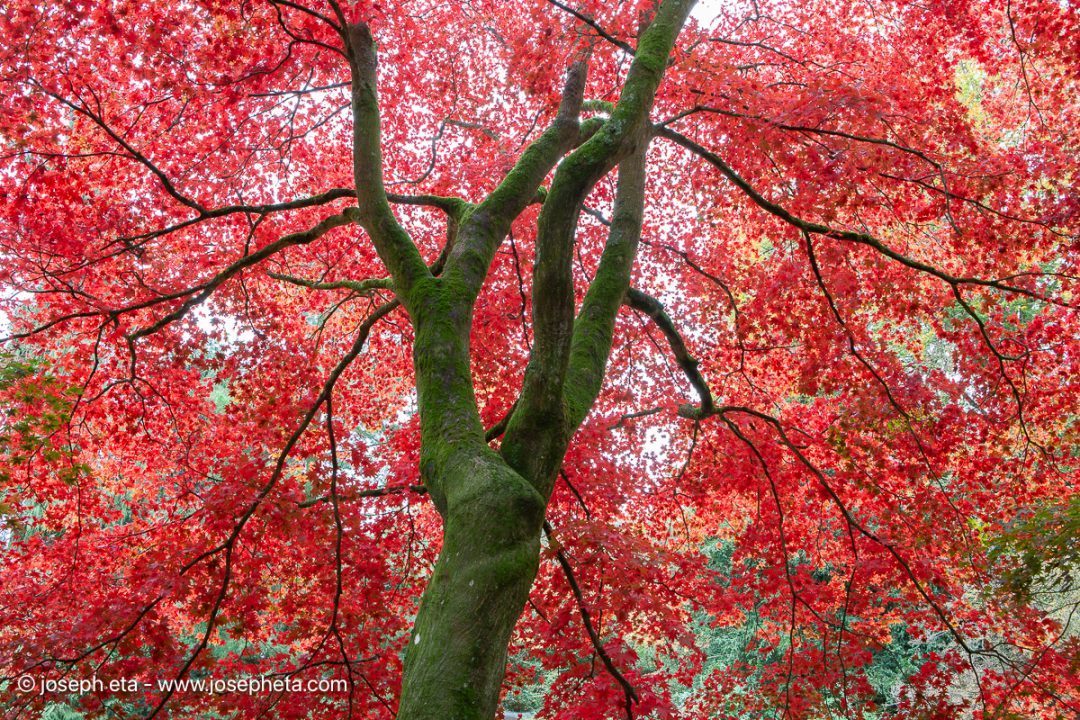
This piece was captured to distill this exact moment of peak kinetic transition.
Shot from a low angle, the composition is anchored by a dark, muscular trunk covered in deep green moss—the permanent, unshakeable core of the organism. Above it, against a stark, blown-out white sky, the canopy explodes in a heavy, saturated crimson.
The vibrant red is not a signal of death; it is the visual peak of the tree’s adaptive energy. By isolating the subject against a pure white background, the image strips away the noise of the forest, presenting the shifting canopy with the graphic, commanding presence of an architectural blueprint.
Curating the Space

Art in the workplace or the modern home should do more than fill empty walls; it should serve as a psychological anchor.
With its explosive vitality and deep structural geometry, this piece is curated specifically for transitional and communal spaces. Placed in a sleek corporate reception area, a high-end executive lounge, or a modern architectural corridor, the aggressive crimson injects a massive pulse of life into minimalist, dark-toned interiors.
It stands as a silent, powerful reminder to those who pass it: change is not a decline. Shedding the obsolete is the ultimate act of vitality.
This piece will soon be available as a strictly limited-edition museum-grade print on my Saatchi Art gallery. To inquire about early acquisition, bespoke sizing, or gallery-grade framing options, please reach out directly via the contact form.


No Comments